Jackson Lewis -- California Raises the Stakes on Pay Data Reporting Failures

Selene Bendeck • 7 October 2026

Governor Newsom has signed Senate Bill (SB) 1237, significantly increasing the penalties for employers who repeatedly fail to file California’s required pay data reports.


Under the new law, first-time failures remain subject to penalties of up to $100 per employee. But for subsequent failures, the maximum penalty jumps from $200 to $1,000 per employee—a fivefold increase.


Miss once, pay a little. Miss twice, pay a lot. A company with 500 employees that misses a second filing deadline could face up to $500,000 in civil penalties—compared to $100,000 under the prior cap. The California Civil Rights Department (CRD) must still obtain a court order to impose penalties, but the dramatically higher ceiling gives the agency considerably more leverage in enforcement actions.


SB 1237 also requires CRD to publish aggregate, anonymized reporting data annually. But individual company filings remain confidential—the statute expressly exempts them from disclosure under the California Public Records Act.


Employers should also note that the May 2027 filing cycle—the first subject to SB 1237’s enhanced penalties—will require reporting under 23 Standard Occupational Classification (SOC) job categories rather than the 10 EEO-1 categories used in prior years. This change, enacted in 2025, requires employers to map each employee to more granular job classifications based on occupational function. Organizations that have not yet updated their HRIS systems or reporting processes should begin preparation now to avoid compliance gaps when the new requirements take effect.


Key Takeaway

SB 1237 takes effect January 1, 2027. Employers with 100 or more employees should use the intervening period to audit their pay data reporting processes, ensure their systems can accommodate SOC-based classifications, and calendar the annual filing deadline (the second Wednesday of May).

For more information, click here:
https://www.californiaworkplacelawblog.com/2026/10/articles/california/california-raises-the-stakes-on-pay-data-reporting-failures/

by Selene Bendeck • 7 October 2026
In summary Companies with more than $100 million in annual worldwide gross receipts will be required to search their records and submit sworn disclosures about slavery-related transactions. Gov. Gavin Newsom signed a first-in-the-nation law that requires large companies to disclose if they or their predecessors profited from chattel slavery. The Truth in Disclosure Act will require major companies operating in the state to disclose these historical and financial ties to enslavement-related transactions. 2 The bill was a top priority for the California Legislative Black Caucus this year. No other state requires corporations to account for their historical role in the slave economy, according to advocates. Authored by Assemblymember Isaac Bryan , a Democrat from Culver City, the law applies to companies with annual worldwide gross receipts over $100 million. Assembly Bill 2599 also requires relevant records and disclosures to be made publicly available through a searchable digital to be established by the state’s Civil Rights Department. The sworn filings will be subject to the penalty of perjury. The first affidavits are due by Jan. 15, 2029. Supporters say the database could be a useful tool for academics, journalists and advocates to examine the connections between current corporate wealth and historical participation in the slave economy. An example of a type of company that would likely have to make such disclosures in California is JP Morgan Chase. According to the California Reparations Task Force report , in 2005, the banking giant wrote a formal apology because two banks that it had taken ownership of had taken 13,000 enslaved people as security for loans in Louisiana. When enslavers could not pay back the loans, the banks took ownership of 1,200 people. The law only applies to companies that existed or whose predecessor company existed on or before December 1964. “I’m thinking agriculture. I’m thinking banking, insurance. I’m thinking anything in the financial sector,” Bryan said about the types of companies he expects may have to file disclosures. “Once the public has this disclosure and we have a full accounting of the impact, then it’s up to us to decide what that means and what we’re going to do about it,” he added. Several insurance companies opposed the measure as it moved through the Legislature. They said they already disclosed their connections to slavery through a 2000 California law that resulted in a publicly available report . The newest law is the latest in a slow, uneven effort to act on the findings of the state’s reparations task force. Newsom created the task force in 2020. After two years of study, it released a 2023 report detailing California’s history of enslavement and discriminatory policies and made more than 100 recommendations. Economists estimated the state owes Black residents at least $800 billion for harms in policing, housing, and health. Lawmakers have since taken small steps. In 2024, Newsom signed six of the Legislative Black Caucus’ 14 priority bills that drew from the task force report, including a formal state apology. That year, the caucus declined to advance two ambitious reparations bills, opening a painful split with grassroots advocates. The California chapter of the Council on American-Islamic Relations and the Alliance for Reparations, Reconciliation and Truth applauded Newsom and Bryan for the new law. “California has long been a state that prides itself on justice and equity and AB 2599 moves the needle closer to the transparency that is necessary to recognize and rectify these historical injustices and understand the roots of modern economic disparities,” said CAIR-CA Chief Executive Hussam Ayloush in a written statement. For more information, click here: https://calmatters.org/justice/2026/10/slavery-disclosure-new-law/
by Selene Bendeck • 7 October 2026
California employees will soon be able to take bereavement leave when an extended relative or someone they consider family dies. Governor Newsom signed SB 1149 late yesterday, allowing employees to take bereavement leave upon the death of a “designated person,” which means any person related to the employee by blood or whose association with the employee is the equivalent of a family relationship. Here are the top three changes and the key steps you should consider taking before it takes effect on January 1, 2027. 1. Employees May Take Bereavement Leave for the Death of a “Designated Person” Currently, California’s bereavement leave law applies only to the death of a spouse, child, parent, sibling, grandparent, grandchild, domestic partner, or parent-in-law. It does not cover extended relatives like aunts, uncles, cousins, or non-blood relationships considered equivalent to family. SB 1149 , however, expands the list of applicable individuals to also include a designated person chosen by the employee, defined as any person related to the employee by blood or whose association with the employee is the equivalent of a family relationship. This will allow employees to take bereavement leave for the death of an extended relative or for an individual who may not be biologically or legally related but has deep, family-like bonds with the employee. This aligns bereavement leave more closely with recent changes made to CFRA Leave and Paid Sick Leave under AB 1041 and that will take effect for Paid Family Leave under SB 590 in 2028. 2. Limitations and Employer Protections SB 1149 implements safeguards for employers in the implementation of the “designated person” language. It limits employees to designating only one such “designated person” per 12-month period. This provision also aligns with the safeguards put in place due to recent changes in paid family leave qualification. SB 1149 does not change how much leave employees get or how they can use it. Eligible employees are still entitled to a minimum of five days of bereavement leave – which can be unpaid or paid – to be completed within three months of the family member or designated person’s death. The dates do not need to be consecutive. 3. Identification and Documentation Request As with prior bereavement leave legislation, SB 1149 allows for the employer to request documentation from the employee of the death of the family member or designated person, which (if requested) the employee is to provide within 30 days of the first day of leave. This documentation can include a death certificate, a published obituary, or a written verification of death, burial, or memorial services from a mortuary, funeral home, burial society, crematorium, religious institution, or government agency. You are required to keep any requested documentation strictly confidential. What Employers Should Do Now Be prepared to update your leave of absence policies and procedures. In preparation for the January 1, 2027, effective date, you should consider taking the following steps: Consider how the new rule aligns with existing CFRA Leave, Paid Sick Leave, and Paid Family Leave policies – especially following AB 1041, which added “designated person” language under CFRA Leave and Paid Sick Leave beginning in 2023, and SB 590, which will add “designated person” language under Paid Family Leave starting July 1, 2028. Review your policies and employee handbooks to ensure they include updated definitions under AB 1041, SB 590, SB 1149, and other applicable laws. Update your information packets and onboarding documents to employees. Train HR staff on the new definition of “designated person.” Consult with your counsel to ensure policies, training, and procedures align with the new requirements.  For more information, click here: https://www.fisherphillips.com/en/insights/insights/california-expands-bereavement-leave-to-cover-extended-and-chosen-family
by Selene Bendeck • 7 October 2026
Quick Hits California is leading the charge to regulate AI use in the workplace with a suite of new laws targeting workplace monitoring and automated decision-making. California’s AB 1883 bans AI-powered workplace surveillance tools that predict employees’ emotional states or collect neural data, and AB 1331 prohibits employers from using workplace surveillance tools to monitor employees in bathrooms. SB 947, the “No Robo Bosses Act,” prohibits employers from relying solely on automated decision systems for discipline or termination decisions, effective July 1, 2027. The bills include Assembly Bill (AB) 1883, which bans AI-driven workplace monitoring tools that make predictions about employees’ emotional states or collect employees’ “neural” data; AB 1331, which prohibits workplace surveillance in bathrooms; Senate Bill (SB) 947, the “No Robo Bosses Act,” which prohibits employers from relying solely on automated decision systems for discipline or termination. Together, these laws increase employers’ potential liability for using AI-powered tools in the workplace. AB 1883—Workplace Surveillance Tools AB 1883 , titled “Workplace surveillance tools,” was enacted as employers are being offered an increasing array of tools that monitor everything from text and audio to biometric factors and behaviors. The law follows the European Union’s lead as the European AI Act already bans AI systems used for emotion recognition in the workplace and in educational settings. AB 1883 bans the use of “workplace surveillance tool[s]” that use AI to either: (1) recognize, or make inferences or predictions about, an individual’s emotional state; or (2) collect neural data. “Workplace surveillance tools” are defined in the law as “any system, application, instrument, or device that collects” information about employees’ activities, communications, biometrics, or behaviors in a way other than direct observation by a human. Such tools include video or audio surveillance, time-tracking, geolocation tools, or others that use “a photo-optical system.” Additionally, the law bans the collection of employees’ “neural data,” meaning information that measures employees’ central or peripheral nervous systems. Violations can result in statutory or civil penalties of up to $500 per violation. Further, although the law does not provide a private right of action, employers may face liability under the California Private Attorney General Act (PAGA), which allows individuals to pursue Labor Code-based penalty claims on behalf of the state. AB 1331—Workplace Surveillance of Employees AB 1331 also targets workplace monitoring or surveillance tools that collect “employee data, activities, communications, actions, biometrics, or behaviors by means other than direct observation by a person.” The law prohibits employers from using a workplace surveillance tool to monitor or surveil employees in workplace bathrooms, with limited exceptions, and allows employees to leave surveillance devices behind when entering those areas. AB 1331 permits employers to require employees to use a “workplace surveillance tool, including a badge or personal alarm system” to “access a locked or secured bathroom” so long as it does not have an audio or video recording capability and “does not have physically embedded or attached artificial intelligence.” AB 1331 shares an enforcement structure with AB 1883, including civil penalties of up to $500 per violation. SB 947—‘No Robo Bosses Act’ SB 947 , known as the “No Robo Bosses Act,” will take effect on July 1, 2027. The law is a newer version of a similar law that Governor Newsom vetoed in 2025. The law prohibits employers from relying solely on an automated decision system (ADS) for discipline or termination decisions, requiring a human reviewer to independently corroborate the ADS output. SB 947 also bars using an ADS to infer a worker’s protected characteristics or to predict and retaliate against a worker for exercising legal rights. Additionally, the law requires employers to provide post-use notice to affected employees when an ADS is used in employment decisions. Increasing Scrutiny of Monitoring Tools Employers have increasingly embraced workplace monitoring tools to increase productivity, efficiency, and workplace health and safety. An array of monitoring tools is now available that exceed traditional text, audio, internet, and keystroke activity recording. These newer technologies collect and analyze employees’ location data; biometric factors such as heart rate, sweating, and brainwaves (often via wearable devices); linguistic data; and visual recordings that capture micro-expressions, body language, and eye movements. Data can then be analyzed using AI to make predictions about employees, potentially their mental states. This can allow employers to intervene when an employee is in danger or provide support when necessary. AB 1883 targets many of these AI-driven tools, but the final version of the law is more narrowly tailored than prior versions. It allows non-AI-powered workplace monitoring tools that are not used for the prohibited purposes and explicitly permits employers to use a “workplace surveillance tool” to “ensure safety.” This addresses concerns from some opponents that the bill would potentially have banned basic security surveillance tools and safety measures, such as sensors that can detect distracted or fatigued drivers. Still, it will be necessary for employers to conduct due diligence on any monitoring tools being implemented or considered to determine what predictions or outputs the tools produce and whether the data collected could be considered “neural data.” Evolving AI Legal Landscape The latest package of bills once again puts California at the forefront of AI regulation in the United States. Whereas, under the current administration, there has been a dearth of federal workplace AI legislation, regulations, or other rulemaking, and no action to address AI-powered monitoring tools is expected in the foreseeable future. The signings come on the heels of Governor Newsom signing two AI executive orders. N-10-26 , also signed on September 30, 2026, declares that all state agencies and departments refer to AI technologies as “artificial intelligence” or “AI” regardless of “any rebranded or different terminology used by the federal government.” Signed on September 18, 2026, N-9-26 directs the state to explore increased oversight of AI development, including potentially requiring a “kill switch” for frontier AI models. In addition, California , Colorado , Connecticut , Illinois , New York City , and Texas all have laws that restrict the use of automated decision tools for significant or consequential employment decisions, such as hiring, promotion, and termination. Those laws could arguably apply to AI-powered employee monitoring tools, particularly if the output of such tools is used to influence key employment decisions. It is expected that states will continue to legislate in this area. Next Steps California continues to be on the frontier of AI legislation. Employers should pay close attention to these new California AI laws and the evolving regulatory landscape governing the use of monitoring and AI-powered tools in the workplace. Before implementing a specific tool, employers may want to thoroughly vet what data the tool collects, how that data will be used, and whether the tool uses AI to generate any output from that data, as these new laws place additional compliance requirements on employers. Employers using automated decision systems for discipline or termination decisions may want to prepare for SB 947’s requirements, including the human reviewer mandate effective July 1, 2027. More broadly, employers may further wish to consider the impact on employee morale and workplace culture when considering the use of a monitoring tool. For more information, click here: https://ogletree.com/insights-resources/blog-posts/california-governor-signs-3-bills-targeting-ai-and-workplace-surveillance/
by Selene Bendeck • 7 October 2026
California employers have discussed disability accommodation for decades, yet these claims remain easy to create accidentally—not because employers usually refuse accommodation outright, but because they skip steps, move too quickly, ask the wrong questions, rely too heavily on medical notes, or treat the process as a one-time decision. The requests are also more complicated: remote work, modified schedules, intermittent leave, assistive devices, service animals, and extended leaves all require careful, individualized analysis. Recognizing the Request Is the First Step Employees do not need to use the words “reasonable accommodation” or identify a particular statute to put an employer on notice that an accommodation may be needed. But there are limits. The California Court of Appeal’s 2026 decision in Husband v. Target Corp. provides an important reminder. The employee engaged in unusual and disturbing workplace behavior during what was later identified as a manic episode associated with bipolar disorder. He had not disclosed his diagnosis or requested an accommodation before the employer decided to terminate his employment. The court rejected the argument that the employer should have recognized the behavior as the manifestation of a disability. An employer’s knowledge of an undisclosed disability will not ordinarily be inferred simply because an employee behaves strangely or a supervisor suspects something may be wrong. Employers should not diagnose employees, but when an employee identifies a medical condition and connects it to a workplace problem or request for assistance, supervisors should involve Human Resources and recognize that the interactive process may have begun. The Interactive Process Is More Than an Approval Form Employers sometimes treat accommodation requests as applications to approve or deny. The better approach is to identify the employee’s limitations, determine which essential functions are affected, and explore reasonable accommodations that would allow the employee to perform the job. The 2025 decision in Allos v. Poway Unified School District is instructive. The employee wanted to work entirely from home because of health concerns during the COVID-19 pandemic. Over more than two years, the district conducted six interactive meetings and provided various accommodations, including a hybrid schedule. The employer did not treat the first request as a yes-or-no decision. It continued meeting with the employee and adjusting the arrangement as circumstances changed, which is the point employers sometimes miss: the interactive process is not a meeting; it is a process. A Doctor’s Note Does Not Decide the Outcome Medical documentation matters when the employee’s limitations or need for accommodation are not obvious, but medical providers do not decide what accommodation is reasonable for a particular workplace. A note saying an employee “must work remotely,” “cannot work weekends,” or “should be transferred” provides information, but it should prompt the employer to understand the functional limitation behind the recommendation. The provider supplies medical restrictions and limitations; the employer evaluates the job and possible accommodations; and the interactive process connects the two. Essential Functions Must Reflect the Real Job Employers cannot meaningfully evaluate an accommodation without understanding the job. That sounds obvious, but accommodation disputes frequently expose job descriptions that are years out of date or bear little resemblance to what the employee actually does. Miller v. Department of Corrections and Rehabilitation, decided in 2024, demonstrates why essential functions matter. The employee was a correctional officer with significant physical restrictions. The Department identified duties she could no longer perform and explored alternatives, including placement in another position. The Court of Appeal ultimately upheld judgment for the employer. The employer prevailed because it identified the actual physical requirements of the correctional officer position and showed why the employee could not perform them even with accommodation. Employers should be able to answer practical questions: how often the function is performed, what happens if it is not performed, and whether reassignment would fundamentally change the position. A job description is evidence. It should not be the entire analysis. Exhausting Leave Does Not Necessarily End the Analysis Another recurring problem arises when an employee exhausts statutory or employer-provided leave. Employers sometimes assume that once protected leave ends, so does the accommodation obligation. That can be a costly mistake. Additional leave may itself constitute a reasonable accommodation. But that does not mean leave must continue forever. Miller is useful here too. The employee had remained unable to work for years, and the court emphasized that FEHA protects employees who can perform the essential functions of the position with or without reasonable accommodation. Accommodation does not require an employer to eliminate essential job duties indefinitely. The distinction is important. A request for another six weeks of leave accompanied by an anticipated return date presents a very different issue from a request for leave with no reasonably identifiable end point. “Leave exhausted” should trigger analysis, not an automatic termination. Safety Concerns Require an Individualized Assessment Some accommodation cases involve legitimate safety concerns, and employers do not have to ignore genuine risks. But a diagnosis alone is not enough; the analysis must focus on the individual employee and the actual job. Generalized assumptions about epilepsy, diabetes, mental health conditions, mobility limitations, or other disabilities are particularly dangerous. The more serious the employer believes the safety risk is, the more important it is to have objective information supporting that conclusion. Good Documentation Cannot Replace a Good Process Employers should document requests, communications, medical information, accommodations considered, decisions made, and follow-up—but documentation cannot substitute for engagement. A perfectly completed form will not rescue an employer that never seriously considered alternatives. Conversely, a thoughtful interactive process can become difficult to defend when no one records what happened or why a particular decision was made. The best accommodation files show both a genuine effort to solve the problem and a clear record of that effort. Employers Should Be Able to Explain How They Got to “No” Accommodation cases usually turn on process: whether the employer understood the employee’s limitations, identified essential functions, explored reasonable options, obtained appropriate information, and made an individualized decision. Employers do not have to say “yes” to every request. But in California, they should be able to explain how they got to “no.”
by Selene Bendeck • 7 October 2026
With California’s September 30 gubernatorial signing deadline behind us, employers can begin preparing for the latest round of changes to California employment law. This year’s legislation covers a wide range of subjects, including artificial intelligence and workplace surveillance, employment agreements, bereavement leave, harassment-prevention training, Labor Commissioner proceedings, pay-data reporting, workplace safety, public works, and several industry-specific issues. Many of the measures discussed below take effect January 1, 2027, although several have later operative dates. Below are some of the most significant laws California employers should have on their radar. Artifical Intelligence and Workplace Surveillance SB 947 imposes new requirements on automated disciplinary and termination decisions California employers using artificial intelligence and other automated tools to manage their workforces will face new restrictions beginning July 1, 2027. SB 947 regulates an “automated decision system” (ADS), broadly defined to include a computational process derived from machine learning, statistical modeling, data analytics, or artificial intelligence that produces a score, classification, recommendation, or other simplified output used to assist or replace human discretionary decision-making and materially impacts individuals. The law does not prohibit employers from using an ADS to make employment decisions, but it implements limits on that use. Among other things, an employer may not use an ADS to infer an employee’s protected status or predict and take adverse action against a worker for exercising legal rights. More significantly for day-to-day employment decisions, an employer may not rely solely on an ADS when making a disciplinary or termination decision. If the employer primarily relies on an ADS output, a human must corroborate the decision using the information underlying the output or other relevant supporting information. If the output cannot be corroborated, or the human reviewer concludes that it is inaccurate, incomplete, or misleading, the employer may not use the output to make the decision. SB 947 also gives an employee the right to request a meaningful, objective description of the employee’s own data used by the ADS when the employer primarily used the system to make a disciplinary or termination decision. At the time the employer communicates such a decision, it also must provide a separate written notice stating, among other things, that an ADS was primarily relied upon, that a human reviewed and corroborated the output, and how the employee can obtain additional information. Employers should begin identifying now which HR, productivity, scheduling, performance-management, security, and other systems use algorithms or artificial intelligence in ways that may affect disciplinary or termination decisions. That inquiry should extend beyond software marketed as an “AI” product because the statutory definition extends to other data-analytics and automated decision-making tools. AB 1331 and AB 1883 restrict certain forms of workplace surveillance Two companion measures impose new limits on employee surveillance beginning January 1, 2027. AB 1331 broadly defines a “workplace surveillance tool” to include systems or devices that collect employee data, activities, communications, actions, biometrics, or behaviors through means other than direct human observation, including video or audio surveillance, incremental time tracking, and geolocation. The law’s substantive restriction is considerably narrower than that definition: absent a court order, employers generally may not use such tools to monitor employees in workplace bathrooms. Employees also generally have the right to leave employer surveillance tools behind when entering a bathroom, subject to specified exceptions for certain safety, identification, access, and on-call requirements. AB 1883 addresses a different category of technology. Employers may not use an AI-enabled workplace surveillance tool to recognize, infer, or predict an employee’s emotional state or to collect “neural data,” which is defined as information generated by measuring activity of the central or peripheral nervous system. Violations may result in penalties of up to $500 per violation. Together with SB 947, these laws mean employers should move quickly to inventory their workplace technology. Employers should understand not only which systems HR has purchased, but also the functionality embedded in security systems, timekeeping programs, wearable devices, productivity software, and vendor-provided platforms. SB 951 adds AI disclosures to certain Cal-WARN notices SB 951 addresses job displacement flowing from workplace automation. The law does not create a new trigger under the California Worker Adjustment and Retraining Notification Act (Cal-WARN) merely because artificial intelligence or automation results in job losses. Rather, when an employer is already required to provide notice of a covered mass layoff, relocation, or termination under Cal-WARN, and that event was caused in whole or substantial part by an AI system or other automated technology replacing or automating positions, the notice must contain additional information. That includes the affected classifications or occupations, job functions being automated, and the category or type of technology substantially responsible for the displacement. The notice also must state at the top that it is a notice of “technology displacement.” Employers contemplating restructuring associated with AI or automation should add this issue to their existing Cal-WARN analysis. Employment Agreements and Arbitration AB 1697 delays and revises California’s restrictions on “stay-or-pay” provisions AB 1697 makes important changes to California’s restrictions on so-called “stay-or-pay” agreements, i.e., contract provisions under which a worker must repay money or incur a financial obligation if the worker leaves employment before a specified date. The Legislature enacted the underlying prohibition in 2025, but AB 1697 delays its application to contracts entered into on or after January 1, 2027 and makes the prior version inoperative during 2026. Beginning in 2027, an employment contract generally may not require a worker, because the employment relationship terminates, to repay a debt, permit collection or forbearance on a debt to resume, or incur a penalty, fee, or cost. AB 1697 also creates several important exceptions. Among them, qualifying tuition-repayment arrangements for transferable credentials may remain permissible if statutory requirements are satisfied: (1) the agreement is separate from any contract for employment; (2) the agreement does not require obtaining the transferable credential as a condition of employment; (3) the agreement specifies the repayment amount before the worker agrees to the contract, and the repayment amount does not exceed the cost to the employer of the transferable credential received by the worker; (4) the agreement provides for a prorated repayment amount during any required employment period that is proportional to the total repayment amount and the length of the required employment period and does not require an accelerated payment schedule if the worker separates from the employment; and (5) the agreement does not require repayment to the employer by the worker if the worker is terminated, except if the worker is terminated for misconduct. Certain discretionary or unearned bonuses (including some signing and retention bonuses) also may contain repayment requirements if, among other things, the repayment obligation is contained in a separate agreement, the employee is notified of the right to consult counsel and receives at least five business days to do so, the obligation is prorated without interest over a retention period not exceeding two years, the employee has the option to defer the bonus until the end of the retention period, and repayment is triggered only by voluntary separation or discharge for misconduct. The law also contains exceptions for certain government-funded programs, approved apprenticeships, specified financial-services arrangements, and limited advances of paid time off. The remedies for violations can be significant. A worker may bring a civil action, including on behalf of similarly situated workers, and recover actual damages or $5,000 per worker, whichever is greater, plus injunctive relief and reasonable attorneys’ fees and costs. Employers should review signing and retention bonuses, education and training repayment agreements, relocation arrangements, advanced paid-time-off programs, and other agreements containing repayment obligations before issuing new agreements in 2027. AB 2155 limits enforcement under the California Arbitration Act where federal law would preclude enforcement AB 2155 adds an important provision to the California Arbitration Act. Beginning January 1, 2027, an agreement is unenforceable under California Code of Civil Procedure section 1281 “to the extent” it would not be enforceable under the Federal Arbitration Act. The Legislature expressly identified the FAA’s transportation-worker exemption and the federal Ending Forced Arbitration of Sexual Assault and Sexual Harassment Act as examples of federal exclusions incorporated into California law. As a result, employers generally cannot rely on the California Arbitration Act as an alternative means of enforcing an arbitration agreement where the FAA itself makes the agreement or dispute unenforceable. Employers with California arbitration programs (particularly employers with employees potentially falling within the FAA’s transportation-worker exemption) should review whether their agreements rely on state law as an alternative enforcement mechanism. Leave, Discrimination and Harassment-Prevention Training SB 1149 expands bereavement leave to a “designated person” California already requires employers with five or more employees to provide an eligible employee with up to five days of bereavement leave following the death of specified family members. Beginning January 1, 2027, SB 1149 expands the definition of “family member” to include a “designated person.” A designated person is an individual related to the employee by blood or whose association with the employee is the equivalent of a family relationship. An employee may identify the designated person when requesting bereavement leave. Employers may limit employees to one designated person during a 12-month period for purposes of bereavement leave. The legislation does not increase the amount of available leave: employees remain entitled to up to five days, which generally must be completed within three months of the death and need not be taken consecutively. Employers should update bereavement policies and leave-request materials before the end of 2026. Employers also should decide whether their policies will expressly exercise the statute’s option to limit employees to one designated person per 12-month period. AB 2563 clarifies the scope of sex discrimination under California law AB 2563 adopts a broad, statewide definition of “sex discrimination” and amends the Fair Employment and Housing Act’s definition of “sex” accordingly. The legislation specifies that sex discrimination includes discrimination based on actual or perceived characteristics such as assigned sex or gender category, conformity to sex or gender stereotypes, gender identity and expression, pregnancy and related medical conditions, pregnancy-related decision making or care, sexual orientation, and variations in sex characteristics. The Legislature characterized these changes as declaratory of existing law rather than an expansion or contraction of existing rights. Employers may have seen proposals this year specifically addressing menopause. AB 2563 contained alternative provisions that would have expressly incorporated perimenopause, menopause, and postmenopause if AB 1940 also became law. The Governor vetoed AB 1940, so those conditional provisions do not become operative. AB 1803 will add anti-hate-speech content to mandatory harassment training California employers with five or more employees already must provide harassment-prevention training every two years: at least two hours for supervisory employees and one hour for nonsupervisory employees. AB 1803 adds anti-hate-speech training to that existing requirement beginning January 1, 2028. The required component will include practical guidance on recognizing, reporting, and confronting workplace speech that vilifies, humiliates, or incites hatred against people based on characteristics protected by the Fair Employment and Housing Act. Importantly, AB 1803 modifies California’s training requirements. It does not create a new standalone statutory cause of action whenever an employee engages in speech falling within the training requirement. Nevertheless, employers should expect the new content to affect how managers are trained to identify and respond to potentially inappropriate workplace conduct. Employers do not need to retrain the workforce immediately. However, employers should confirm that internal training programs and third-party vendors will incorporate the new material when the requirement becomes operative in 2028. Employers revising their harassment, discrimination, and workplace-conduct policies during 2027 may want to coordinate those revisions with the new training requirements. Wage-and-Hour Enforcement and Pay-Data Reporting SB 1316 raises the stakes for responding to Labor Commissioner document requests SB 1316 makes several procedural changes that matter when an employer is investigated by the Labor Commissioner. Most significantly, the law expands circumstances in which an employer may be barred from using payroll, timekeeping, personnel, and other required employment records if the employer fails to produce those records in response to a timely Labor Commissioner request. The amended statute generally gives an employer at least 15 days to respond to a records request, although the Labor Commissioner may establish a shorter period where circumstances require it. When the original request provides at least 15 days to respond, an employer that timely responds in good faith that additional time is needed receives an automatic 15-day extension. The Labor Commissioner also must consider reasonable extension requests. The consequences of noncompliance could be significant. Records not timely produced may be excluded not merely as affirmative evidence but from being “used or relied on” during the administrative or writ proceeding, including for impeachment. Similar rules will apply in specified public-works proceedings. SB 1316 also strengthens the Labor Commissioner’s collection tools by permitting liens securing final Labor Commissioner awards to be renewed for additional 10-year periods. For employers, a Labor Commissioner document request should be treated much like formal discovery with an imminent evidentiary deadline. Employers should promptly preserve and collect responsive records, document any difficulty completing the production, and request additional time before the deadline rather than assuming documents can be produced later. SB 1444 modernizes Labor Commissioner service and expands a misclassification remedy The Legislature also enacted SB 1444 , an employment omnibus bill containing several changes to Labor Commissioner proceedings. Among other things, a represented party in a Labor Commissioner proceeding must provide counsel’s email address and accept electronic service from the Labor Commissioner. Parties also must notify the Labor Commissioner of changes to their electronic address while a claim is pending. (Amending Cal. Labor Code §§ 98, 98.1). SB 1444 also modifies Labor Code section 226.8 , which governs willful independent-contractor misclassification. Under SB 1444, civil penalties may now be recovered as damages by the employee, the Labor Commissioner, or a public prosecutor (alternatively). The underlying statutory penalties for willful misclassification remain substantial, ranging from $5,000 to $15,000 per violation and from $10,000 to $25,000 where there is a pattern or practice. Employers involved in DLSE proceedings should ensure that responsibility for electronic notices is clearly assigned and monitored. Employers using independent contractors should likewise continue to treat classification as a substantive compliance issue rather than merely a payroll designation. SB 1237 increases the penalty for repeated failures to file pay-data reports California private employers with 100 or more employees generally must file an annual pay-data report with the Civil Rights Department. Employers with 100 or more workers supplied through labor contractors generally must file a separate labor-contractor report. SB 1237 does not change those basic thresholds. However, it substantially increases the potential penalty for repeated noncompliance. A court may continue to impose a penalty of up to $100 per employee for an initial failure to file, but the maximum penalty for a subsequent failure increases from $200 to $1,000 per employee. For covered employers, the increased penalty makes ownership of the annual reporting process a critical task. Workplace Safety and Violence AB 2321 increases the potential criminal consequences associated with Cal/OSHA investigations AB 2321 expands the criminal-enforcement aspects of California’s workplace-safety laws. Among other things, the new law makes it a misdemeanor to willfully resist, prevent, impede, or interfere with the Cal/OSHA Chief or an authorized representative in performing specified investigative duties, or to willfully violate a related court order. The legislation also expands specified criminal provisions involving willful safety violations causing serious injury, illness, or exposure and increases coordination between Cal/OSHA’s Bureau of Investigations and prosecuting authorities. Employers responding to a serious workplace accident should ensure that managers and site personnel understand who will interact with Cal/OSHA investigators and that the employer’s response plans preserve both cooperation with the agency and applicable legal privileges. AB 1961 expands the scope of workplace-violence restraining orders AB 1961 gives employers a broader tool when threats are directed at a workplace generally rather than a particular employee. If harassment, unlawful violence, or a credible threat of violence is directed at a workplace or a location where a group of employees performs its primary duties, an employer may seek a workplace-violence restraining order on behalf of all employees at that location without identifying an individual employee as the protected party. A related measure, AB 2179 , will permit parties and witnesses in workplace-violence restraining-order proceedings to appear remotely beginning January 1, 2028 and requires courts to permit electronic filing of specified documents. Public Works, Construction, and Workforce Development AB 1198 changes how prevailing-wage determinations will apply to certain projects Employers performing public works should pay particular attention to AB 1198 , which changes the rules governing updated prevailing-wage determinations. Beginning July 1, 2027, the legislation establishes new rules governing when revised prevailing-wage determinations apply and creates procedures for challenging a new determination. For covered projects (i.e., at least $35,000,000), contractors, awarding bodies, and representatives of affected crafts or classifications may petition the Director of Industrial Relations to review a changed prevailing-wage rate under the procedures established by the legislation. Certain affordable-housing projects are subject to a separate rule under newly enacted Labor Code section 1773.65. For public-works contractors, AB 1198 should be considered together with SB 1316’s new evidentiary rules for Labor Commissioner document requests (discussed above). Failure to timely produce records requested during a public-works investigation may limit the contractor’s ability to rely on those records later in administrative or writ proceedings. SB 909 increases penalties for public-works violations SB 909 significantly increases the financial consequences of several public-works violations. Among other things, the law increases the amount the Director of Industrial Relations may establish as an annual contractor registration or renewal fee without formal rulemaking from $800 to $1,000. It also increases the maximum prevailing-wage penalty to $280 for each calendar day, or portion thereof, for each underpaid worker, with statutory minimums of $56 for most violations, $112 for certain repeat violations, and $168 for willful violations. Other penalties increase as well. Failure to timely produce required certified-payroll records may result in a penalty of $140 per worker for each day of noncompliance. Knowing apprenticeship violations may result in penalties of up to $140 per day, increasing to $420 per day for specified repeat violations. Violations of skilled-and-trained-workforce requirements may carry penalties of up to $5,000 per month for a first violation and $10,000 per month for subsequent violations within three years. The law also directs civil penalties collected by the Labor Commissioner under the public-works chapter into the State Public Works Enforcement Fund, which may be used to support public-works enforcement staffing. Public-works contractors should strengthen payroll, apprenticeship, prevailing-wage, and subcontractor-compliance controls in light of the increased penalties. Other construction and apprenticeship legislation The Governor also signed several measures directed at California’s construction and workforce-development systems, including SB 1227 , which establishes a Department of Industrial Relations apprenticeship pilot program, and AB 1980 , which establishes the Equal Representation in Construction Apprenticeships Grant Program. These measures are more targeted than the generally applicable employment laws discussed above, but contractors, apprenticeship programs, unions, and employers that regularly perform public work should evaluate their potential application. Health Care, Education, and Other Industry-Specific Changes Several additional bills principally affect particular sectors. AB 2311 authorizes qualifying health care districts to employ physicians under specified conditions AB 2311 creates an additional exception to California’s general prohibition against the corporate practice of medicine until its January 1, 2037 sunset. Qualifying health care districts and nonprofit corporations whose sole corporate member is a health care district and that own or control a statutorily qualifying general acute care hospital may employ physicians and surgeons and charge for their professional services if the statutory conditions are satisfied. Those conditions include protections against interference with physicians’ professional judgment and annual reporting requirements. Schools and Higher-Education Employers Face Additional Requirements Education employers face an unusually dense group of new laws. For K–12 schools, AB 1381 requires applicants for certificated positions to disclose their prior education employers and requires prospective school employers to inquire about specified prior complaints, investigations, or discipline involving egregious misconduct. Failure by specified administrators to complete required employment-history inquiries may constitute unprofessional conduct. SB 1083 similarly expands and clarifies investigation, reporting, hiring, and statewide-data-system requirements concerning egregious misconduct by noncertificated public-school and private-school employees, including requirements that covered employers continue certain investigations after separation and, for private schools, adopt written employee-investigation policies by July 1, 2027. AB 2120 makes narrower, Los Angeles Unified School District-specific changes to merit-system hiring and layoff rules, while SB 998 defines the responsibilities of statewide discrimination-prevention coordinators and adds a Disability Discrimination Prevention Coordinator within the Office of Civil Rights. Postsecondary institutions likewise face several significant changes. Several additional measures impose student-facing compliance duties rather than employment obligations, although implementation may involve human resources, Title IX, student-affairs, and designated compliance personnel. Beginning September 1, 2027, AB 1784 expands state nondiscrimination protections concerning marital status, familial status, and pregnancy or pregnancy-related conditions, requires reasonable accommodations for pregnant students, and requires institutions to designate an employee to coordinate compliance. AB 1928 requires covered postsecondary institutions to permit a complainant or respondent in a sexual-harassment proceeding to have both a support person and an advisor during the grievance process. Beginning August 1, 2027, AB 2212 updates postsecondary sexual-harassment and sexual-exploitation standards to address conduct including digitized sexually explicit material, sextortion, and other technology-facilitated sexual harassment, with corresponding effects on institutional policies and training. Immigration Support Workers AB 2624 creates new privacy protections for immigration-support workers and volunteers AB 2624 expands California’s address-confidentiality protections to certain people who provide immigration support services and who face qualifying threats, harassment, or violence because of that work. The legislation also creates restrictions concerning the disclosure of specified personal information about covered individuals. The measure is not a generally applicable employment statute. Organizations providing immigration legal, humanitarian, or related services should nevertheless determine whether employees or volunteers may qualify for the new protections and whether existing privacy and information-security practices need adjustment. Agricultural Worker Minimum Wage AB 2646 establishes a special minimum wage for certain agricultural workers AB 2646 adds a new minimum-wage requirement for specified agricultural employees. New Labor Code section 1208 establishes a base minimum hourly wage of $19.75 for an “approved agricultural employee,” generally meaning an out-of-state resident permitted to work temporarily or seasonally through an application or job order approved in whole or in part by the Labor and Workforce Development Agency or Employment Development Department, and for a “corresponding employee.” A corresponding employee is a California resident performing the same or substantially similar agricultural work during the same time period for the same employer in the same county. The statutory wage is subject to an annual adjustment tied to the Social Security cost-of-living adjustment beginning January 1, 2027 and each January thereafter. Agricultural employers using covered temporary or seasonal out-of-state workers therefore should identify corresponding California employees and ensure that both groups receive at least the applicable statutory rate. Five Things California Employers Should Do Before the End of 2026 With January 1 approaching, employers should prioritize the following: Review AI and workplace-surveillance technology. Employers should determine which systems use AI, algorithms, analytics, geolocation, productivity monitoring, biometrics, or other employee data. Employers should identify whether any are used in disciplinary or termination decisions. Employers also should review their vendors’ practices against the obligations arising under SB 947, AB 1331, and AB 1883. Although SB 947 does not become operative until July 1, 2027, understanding the technology already in use may take considerably longer than revising a policy. Review repayment and “stay-or-pay” agreements. Employers should review signing and retention bonuses, education and training repayment agreements, relocation arrangements, advanced PTO, and other agreements requiring repayment following separation. New agreements entered on or after January 1, 2027, should be reviewed against AB 1697’s requirements and exceptions. Update leave and EEO policies. Employers should revise bereavement policies to account for SB 1149’s “designated person,” decide whether to use the one-designated-person-per-12-month limitation, and review EEO policy terminology in light of AB 2563. Tighten agency-response and reporting procedures. Establish a clear protocol for responding to Labor Commissioner record requests under SB 1316, monitoring electronic service under SB 1444, and completing annual CRD pay-data reporting given SB 1237’s increased penalties. Review the 2027–2028 compliance calendar. Employers with arbitration programs should evaluate AB 2155. Employers planning reductions-in-force flowing from the use of AI should incorporate SB 951 into Cal-WARN planning. And employers should ensure harassment-training programs are updated for AB 1803 before its January 1, 2028 operative date. Public-works contractors, health care employers, educational institutions, agricultural employers, and other employers subject to industry-specific legislation should conduct a separate review of the measures applicable to their operations. For more information, click here: https://www.jdsupra.com/legalnews/new-california-employment-laws-5357757/

by Angela Perry • 2 September 2026
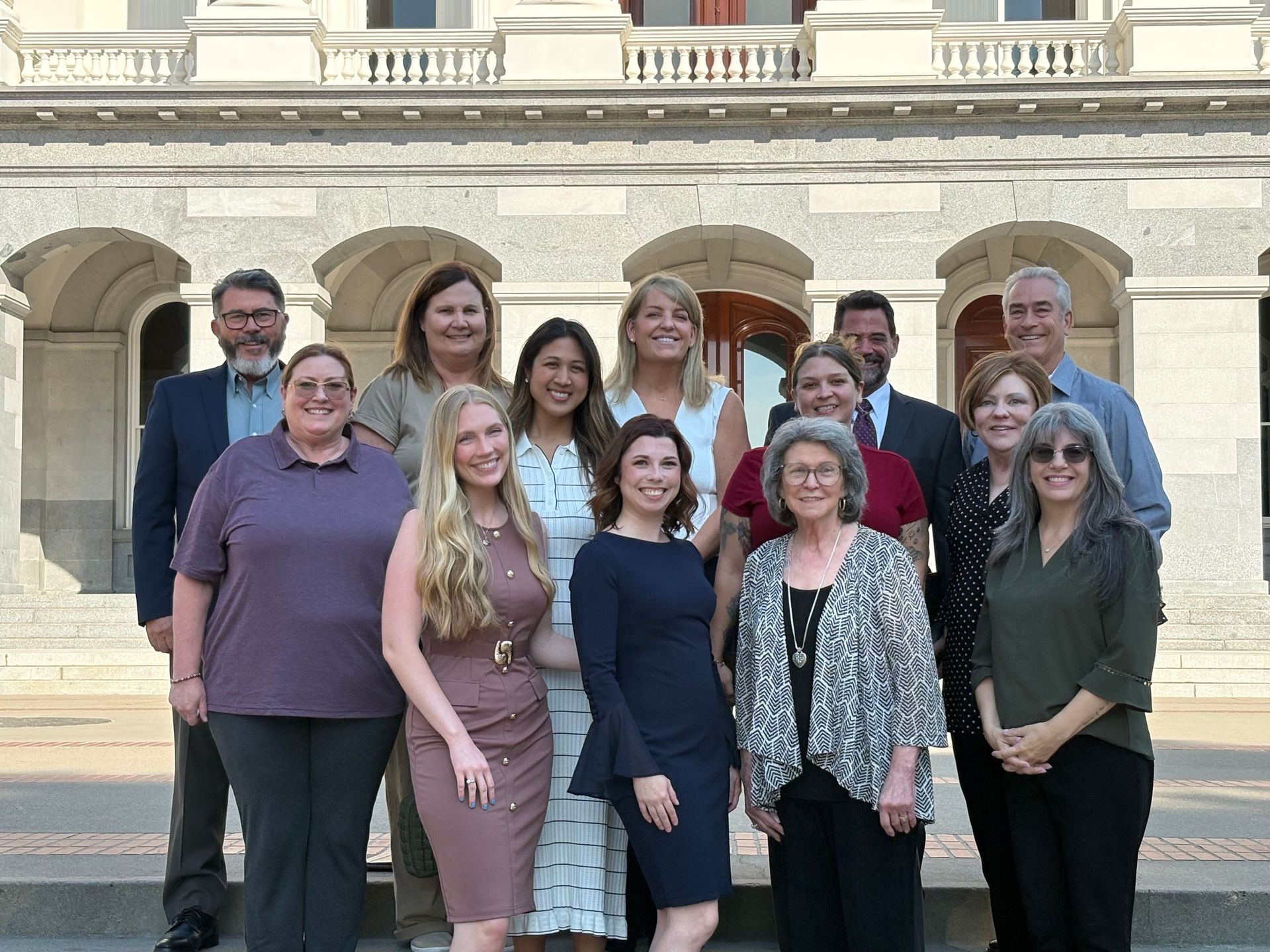
On Wednesday, August 12th, UCAN members traveled to the State Capitol in Sacramento for our annual Legislative Visit Day. These visits are a great way for UCAN's member Chambers to stay connected with our state elected officials and to discuss the policy and regulatory issues affecting the business community in our region. This year we had a representative from every UCAN Chamber — a new attendance record for the coalition. The day began at 11:30 a.m. with lunch at the California Manufacturers & Technology Association (CMTA), where attendees heard from CMTA President and CEO Lance Hastings and Mike Douglas, General Manager at PRIDE Industries, on the state of manufacturing at both the statewide and local level. After lunch, the group moved to the "Swing Space," the aptly named office building temporarily housing the Legislature and its staff while the Capitol Annex is torn down and rebuilt to modern standards over the next two years. We reserved a conference room there and invited legislators to stop by. In person, we met with Senator Niello and Assemblymembers Hadwick and Hoover; Assemblymembers Nguyen, Patterson, and Flora, along with Senator Ashby, sent staff in their place. Advocacy: opposing AB 2564: A central topic of discussion was our opposition to AB 2564 (Ward), which addresses so-called "surveillance pricing." UCAN opposes the bill because it would: Prevent retail businesses — including Chambers — from offering customer-specific pricing and discounts Use ambiguous, undefined terms that create compliance and liability exposure Open the door to frivolous litigation by private citizens against community businesses For context, AB 2564 would prevent a retail business from offering pricing such as veteran or senior discounts, member versus non-member pricing, and incentives or discounts for new or repeat customers. A new format: opportunities and challenges: We also tried something new this year: asking each attending Chamber to share the top opportunity and top challenge facing its immediate area. It was a highlight of the afternoon, sparking real dialogue with legislators and staff on topics ranging from workforce development and data centers to regulatory reform and AI. We plan to build on this format at future Legislative Visit Days. After our meetings — and a stop on the Capitol steps for a group photo — we returned to CMTA for an evening reception hosted by the Roseville Chamber. The reception brought together Chamber leaders and volunteers, regional elected officials, staff, and lobbyists, with an appearance by Assemblyman Joe Patterson. Toasting the day over appetizers and good conversation was a fitting way to close things out. UCAN is grateful that our state legislators make time to hear directly from local Chamber executives and volunteers on these visits. It's a real testament to the recognition our coalition has earned as a regional policy voice, and to how seriously our elected officials take the needs of the business community. We look forward to welcoming you on a future visit.
by Selene Bendeck • 16 June 2026
Employment Law & Data Privacy Risks Employers Face
by Selene Bendeck • 16 June 2026
Common Employer Pitfalls and Best Practices
by Selene Bendeck • 1 June 2026
On May 21, 2026, California Governor Gavin Newsom signed Executive Order N-6-26 —a sweeping directive aimed squarely at understanding, measuring, and managing the impact of AI on California’s labor market (the “EO”). The EO reflects significant concern about AI’s potential major impact on all sectors of California’s economy. Why This Order, and Why Now? The already rapid pace of deployment of workplace AI tools continues to accelerate. With this profound shift, the labor market is experiencing significant transformation as employers seek to unlock the substantial potential productivity gains associated with AI adoption.[1] AI is being cited by employers as the primary or sole reason for more than a quarter of recent layoffs.[2] California sits at the center of this transformation. But with no state legislation passed to specifically address the impact of AI deployment upon the labor market, the Governor has responded through executive action. This is not the first executive order on AI. A prior executive order, issued on March 30, 2026, directed the Executive Branch to ensure AI procurement and adoption protect civil rights, civil liberties, and privacy. The new EO builds on that foundation—but this time, the focus is on jobs. The Focus of the EO Is to Build a Response Framework The EO is primarily directive in nature, tasking state agencies with conducting reviews, producing reports, and developing recommendations within defined timeframes. Here are the most consequential elements for employers: WARN Act Modernization. Within 180 days, the Labor and Workforce Development Agency (LWDA) must review and provide recommendations on revisions and updates to the California Worker Adjustment and Retraining Notification (Cal-WARN) Act, in a manner that is responsive to and effectively provides early warning data on emerging industry trends. The Cal-WARN Act already imposes pre-layoff notice obligations on qualifying employers. A revision tailored to AI-driven workforce reductions could expand the scope of who is covered, shorten notice windows, or impose new reporting triggers. Safety Net Review for Retrenched Workers. Within 180 days, the LWDA must submit to the Governor a review of policies and practices that provide displaced workers with a safety net, including severance and other forms of compensation such as stock or other forms of equity, along with any recommendations for incorporating such policies or strengthening existing programs. This review will include a comparative analysis of practices in other countries—suggesting California may look to European models of worker protection as a potential template. This is particularly notable because , unlike California, the member states of the European Union do not generally recognize at-will employment, but instead regulate employers’ ability to discharge employees. Collective Bargaining and Worker Voice. No later than October 15, 2026, the LWDA, in consultation with labor organizations, employer groups, and relevant experts, must review how the collective bargaining process is incorporating and addressing new technologies such as AI, in ways tailored to the specific needs of workers and employers, including how worker voice is incorporated in the adoption of emerging technologies, to identify what can be learned from unionized workplaces. For employers in non-union environments, this review could foreshadow future legislative or regulatory requirements around employee consultation or consent before deploying AI tools in the workplace. We previously wrote about regulatory developments concerning the use of AI in employment decision-making here . An AI Employment Dashboard. The Employment Development Department (EDD) is directed to launch a dashboard showing AI’s impacts on employment across various sectors using Unemployment Insurance data within 90 days of the Order’s issuance. This will create publicly accessible, sector-by-sector data on AI-related job displacement—data that will almost certainly be relied upon in future policy and legislative debates. Incentive Structures for Public-Good AI. No later than October 15, 2026, the Government Operations Agency must provide the Governor with options and recommendations for actions that could alter incentive structures and increase the likelihood of AI development and deployments that advance the public good, including potentially mandatory programs that direct a portion of revenue generated by AI companies to support beneficial deployments. A revenue-sharing mandate directed at AI companies would be unprecedented and would have significant implications for how AI firms structure their California operations. Reading the Signals California already has robust worker protection laws that apply to firms adopting emerging technologies. But with this EO, the Governor’s message is that these existing tools may not be sufficient for the pace and scale of AI disruption. Amendments are coming. This EO reflects a broader national and global trend. States and federal agencies alike are wrestling with how to regulate AI’s labor market effects. California’s actions often presage federal legislative activity and serve as models for other states. What California does today, others do tomorrow. The EO sets in motion a series of agency reviews and recommendations that will almost certainly become the foundation for new legislation and regulations in 2027 and beyond. Keeping up to date on the latest legal developments in the AI space will continue to be a top priority for California employers. FOOTNOTES [1] Davenport, Thomas & Srinivasan, Laks, “Companies Are Laying Off Workers Because of AI’s Potential, Not Its Performance,” Harvard Business Review, January 2026, https://hbr.org/2026/01/companies-are-laying-off-workers-because-of-ais-potential-not-its-performance . [2] “Challenger Report: April Job Cuts Rise 38% from March; YTD Cuts Down 50%,” Challenger, Gray & Christmas, May 7, 2026, https://www.challengergray.com/blog/challenger-report-april-job-cuts-rise-38-from-march-ytd-cuts-down-50/ .
by Selene Bendeck • 8 May 2026
Most employment lawsuits don’t start with dramatic misconduct or bad actors. They start with small, avoidable decisions that no one thought would matter—until they did. In my experience representing employers, the practices that cause the most damage are rarely exotic or cutting‑edge. They’re the routine, “we’ll get to it later” items: missing documentation, inconsistent discipline, outdated policies, or decisions made out of frustration instead of process. Employment law rewards preparation and punishes procrastination. The difference between a defensible workplace decision and an expensive lawsuit is often just a few steps that were skipped when things felt busy or manageable. What follows are ten mistakes management‑side employment attorneys see over and over again—and that are far easier to prevent than to defend. Mistake #1: Treating documentation like a chore instead of a shield. In the world of employment law, if you didn’t write it down, it didn’t happen. I’ve seen too many cases lost because management never documented poor performance or gave glowing reviews to an underperforming employee. Here’s a good rule of thumb: if you’re going to take an adverse action against an employee, a stranger should be able to walk in off the street, only review your documentation, and tell you why it was necessary. Mistake #2: Letting things get personal. When a manager’s frustration starts driving employment decisions, you’re headed for trouble. For example, if an employee corrects the behavior they were disciplined for and you fire them anyway without any justification, it’s going to look suspicious. Bring in another supervisor who can evaluate the situation objectively. Mistake #3: Inconsistency in how you treat employees. If I could give employers one piece of advice, it’s this: be consistent. If it’s fine for your favorite employee to come in late three times a week, you can’t fire someone else for the same thing. If you’re absolutely convinced it’s appropriate to treat an employee differently, you had better document that very carefully in writing and make sure you’ve got a policy to back it up. Mistake #4: Neglecting your handbook and policies. Think of your employee handbook as an insurance policy: it sets expectations, communicates standards, and takes away the “I had no idea” defense from employees who violate them. But it’s a double-edged sword—you need to know what’s in it and actually follow it, because a plaintiff’s lawyer will absolutely point to your own policies and ask why you didn’t. Review it annually and don’t be one of those employers whose handbook hasn’t been updated since the Clinton administration. Mistake #5: Retaliating (even when you don’t think you are). Anti-retaliation provisions are baked into virtually every discrimination law as well as many other laws. The sooner you take an adverse action after someone complains, the more it looks like retaliation. I’ve seen managers get fed up with chronic complainers, and it resulted in a huge liability for the employer. If someone has recently complained and needs to be seriously disciplined or terminated, bring in a decision-maker who has no knowledge of the complaint and let them call the shot. Mistake #6: Botching the interactive process under the Americans with Disabilities Act (ADA). When someone asks for an accommodation, the employer is generally in the driver’s seat when it comes to determining what’s reasonable, but the employer has to engage in the interactive process. The interactive process is not a one-way suggestion box—it’s more like couples counseling: if only one party shows up, nobody gets better. When an employee requests an accommodation, request appropriate medical documentation explaining how their specific limitations impact their specific job duties, and ask how long they’ll need the accommodation. If they don’t respond, follow up in writing. That paper trail will be your best friend when the employee claims you failed to accommodate them. Mistake #7: Misclassifying employees under wage and hour laws. Wage and hour law is one of those areas where employers get into trouble because they assume the answer is simpler than it actually is. Whether it’s classifying someone as exempt based on their title instead of their actual duties, or assuming a worker is an independent contractor when the law says otherwise, the consequences of getting it wrong include liability for unpaid wages, double damages, and attorneys’ fees—and it adds up fast when multiple employees are affected. Mistake #8: Ignoring the value of a good investigation. I know of an organization that tried to handle serious misconduct allegations with inexperienced consultants. It was a disaster—they ended up commissioning another investigation (with an experienced law firm) into why the first one went so poorly. Investigating sensitive workplace situations is like surgery: it’s generally not advisable to perform it on yourself. When serious allegations arise, bring in outside counsel with investigative experience. Mistake #9: Assuming “at-will” means “bulletproof.” I hear this all the time: “We’re an at-will state, so we can fire anyone for any reason.” You can fire an employee for any lawful There’s a complex web of state and federal protections you might not be thinking about. At-will employment is not a force field against discrimination, retaliation, or wrongful termination claims. Mistake #10: Waiting too long to call an employment lawyer. I know this sounds self-serving, but hear me out. I’ve seen too many HR professionals reach out to a general business attorney who mostly does real estate or contracts. That’s like suspecting you’re having a stroke and going to your family practitioner for a checkup. The half-hour you spend talking to an employment lawyer is a lot cheaper than the half-a-million dollars that can be spent on litigation. If your gut says you’ve got an employment law-specific problem, listen to it and call someone who practices in that area. Most of these mistakes come down to documentation, consistency, and early intervention. The longer you let things fester, the harder they are to fix—and the more expensive they become. Think of it this way: nobody ever called their employment lawyer and said, “I wish I’d waited longer to reach out.” If any of these hit close to home, give us a call. We’re happy to help you get ahead of the problem before it gets ahead of you.